
ADVANCED MASTER
GENERATIVE, IMMERSIVE ART & MOTION DESIGN
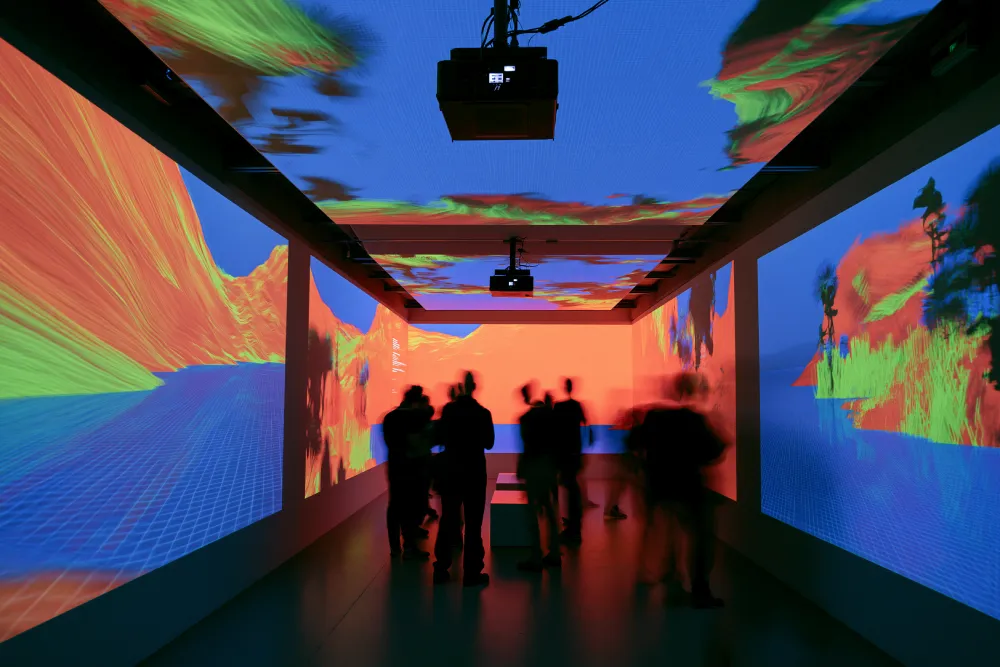
Combine generative art, motion design, sound, and interaction to create installations, brand activations, and digital stage sets. Learn to conceive and produce experiences that connect audiovisual content with space and audience participation.
Introduction
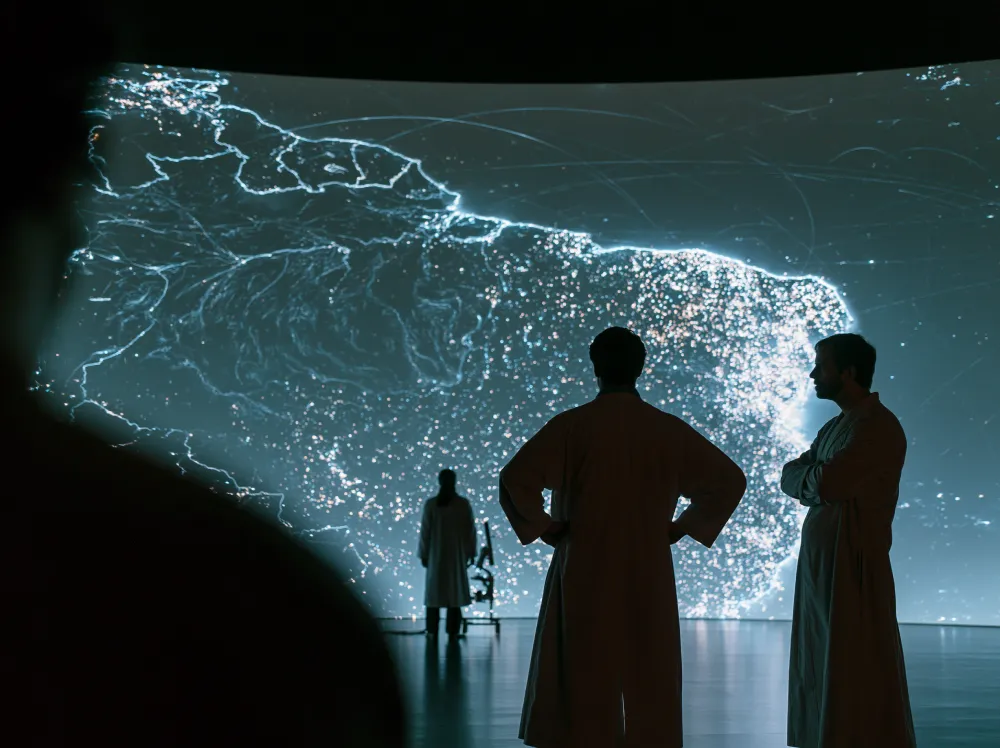
ESDI’s Master’s in Generative, Immersive, and Real-Time Motion Design prepares you to conceive and produce experiences that connect image, sound, space, and audience. You will learn to create visual systems that react to music, movement, and data, applying generative art and real-time technologies. This specialisation equips you to develop installations, brand activations, and digital stage designs with a vision that combines creativity, experience management, and technical expertise.
The programme integrates TOUCHDESIGNER, RESOLUME, and UNREAL ENGINE with creative programming, artificial intelligence, mapping, and sound design. Through workshops and projects, you’ll work on everything from generating visuals to interacting with sensors and planning the installation. You’ll also explore spatial storytelling, brand consistency, budgeting, and professional responsibility. The master’s programme culminates in a project based on a real-world brief, which you’ll present through a prototype or scale model.
Key information
-
CERTIFICATION
ESDI Advanced Education’s own certificate. Private, non-university training without ECTS credits
-
PRICE
To be consulted
-
DURATION
225 hours, distributed between 2-3 days per week and 3-4 hours per day
-
MODE
Blended learning: Face-to-face classes at ESDI Sabadell + one online session per week
-
NEXT CALL FOR APPLICATIONS
April 2027
-
LANGUAGE
Spanish
Curriculum
The curriculum connects generative art, real-time tools, and experience management. Through nine modules, you will learn to integrate image, sound, light, and interaction into proposals for brands, events, and spaces, culminating in a final project based on a real-world brief.
-
M1. GENERATIVE ART AND REAL-TIME VISUAL CULTURE.
· Historical and contemporary references of generative art.
· Algorithmic systems and generative aesthetics.
· Reactive image and real-time visual culture.
· Visual criteria applied to brands, events and spaces.
· Exercises in the analysis and creation of generative systems. -
M2. TOUCHDESIGNER AND RESOLUME: REAL-TIME VISUAL PRODUCTION.
· Nodal environment and construction of visual systems.
· Generation of 2D and 3D content.
· Real-time rendering and visual production.
· VJing and projection.
· Development of systems adaptable to facilities and shows. -
M3. CREATIVE PROGRAMMING AND AI FOR INTERACTIVE SYSTEMS.
· Python applied to TouchDesigner.
· Logic and operation of interactive systems.
· Generation of visuals and behaviors with AI.
· Scripting and automation with AI assistants.
· Building reactive systems through creative programming. -
M4. VIDEO-MAPPING, LIGHTING AND DIGITAL STAGE DESIGN.
· Video mapping, pixel mapping and architectural projection.
· DMX and lighting control.
· Light simulation and calibration.
· Digital set design and visual dramaturgy.
· Development of experiences for physical spaces and events. -
M5. REAL-TIME WITH UNREAL ENGINE AND IMMERSIVE PRODUCTION.
· Creation of real-time environments with Unreal Engine.
· 3D motion graphics and rendering.
· Content for LED screens and spaces.
· Augmented reality and virtual reality: AR/VR.
· Audiovisual and immersive production for brand experiences. -
M6. SOUND DESIGN AND REACTIVE AUDIO.
· Fundamentals of sound design.
· Generative and reactive audio.
· Audiovisual synchronization.
· Real-time relationship between sound and image.
· Integration of sound into installations and shows. -
M7. INTERACTION, SENSORS AND DATA VISUALIZATION.
· Sensors and gathering information from the environment.
· Artificial vision with AI and depth cameras.
· Whole-body interaction and visual and auditory responses.
· Communication via OSC and MIDI.
· Real-time data visualization. -
M8. DIRECTION OF EXPERIENCE, ETHICS AND PROFESSIONAL PRODUCTION.
· Spatial narrative and dramaturgy of events.
· Public relations and brand consistency.
· Budgets and team organization.
· On-site assembly planning.
· Ethics and intellectual property.
· Use of AI and data in public spaces. -
M9. INTEGRATIVE PROJECT WITH COMPANY, BRAND OR EVENT.
· Interpretation of a real briefing.
· Conceptualization of an immersive experience.
· Integration of real-time, AI, sound, interaction, and experience management.
· Development of a prototype or scale model.
· Presentation and defense before an academic tribunal and external professionals.
Methodology
The programme combines conceptual foundations with workshops in visual production, creative programming, mapping, sound, and interaction. You will learn to connect tools and disciplines through exercises applied to installations, events, and brand experiences, relating content design to its behaviour in space.
The projects allow you to progress from concept to prototype, incorporating decisions about narrative, audience participation, and staging. The integrative project begins with a real-world brief and culminates in a prototype or scale model that you will present to a panel of academics and external professionals, explaining both the creative proposal and the production decisions.

Career opportunities
Depending on your training, experience, and interests, this specialisation allows you to direct your professional development towards profiles such as:
-
Director/Producer of Immersive Experiences for Brands and Events
-
Real-Time Visual Designer or Real-Time Motion Designer
-
Creative Technologist
-
Video-Mapping Artist or Show Designer
-
Unreal Real-Time Artist or XR Experience Designer
-
Interactive Installation and Data Visualization Designer
-
TouchDesigner Artist
-
VJ or Live Visual Operator
The programme is aimed at motion designers, designers, creatives, VJs, and audiovisual professionals who want to work with real-time imagery and spatial experiences. It is also designed for professionals looking to focus their work on immersive projects for brands, events, and installations.
Training or experience in design, motion graphics, audiovisual, digital creation, VJing or related real-time fields is recommended, along with the ability and interest to work with digital production tools.
-
Applying the fundamentals of generative art and visual culture to real-time experiences.
-
Develop visual production processes with TouchDesigner and Resolume.
-
Build interactive systems using creative programming, Python, and AI.
-
Create proposals for video mapping, lighting and digital set design.
-
Use Unreal Engine to develop audiovisual and immersive content.
-
Integrate sound, reactive audio, sensors, machine vision, and data visualisation.
-
Develop experience-based management criteria, spatial narrative, and professional production skills.
-
To conceive and present an integrative project that responds to a real briefing.
Programme conceptualisation
-
He studied Photography at the IEFC in Barcelona, a Postgraduate degree in Photography and CGI from the CITM, a Master’s degree in Animation and 3D Art from the UPC, and has taken courses in ZBrush and Houdini. He has over 15 years of experience working as a 3D generalist in various fields and as a lecturer in 3D modeling, texturing, rigging, rendering, and procedural development at both advanced vocational training and undergraduate levels in several institutions.

Request information
Do you have any questions? You can submit the form or contact us via WhatsApp, email, or phone.