
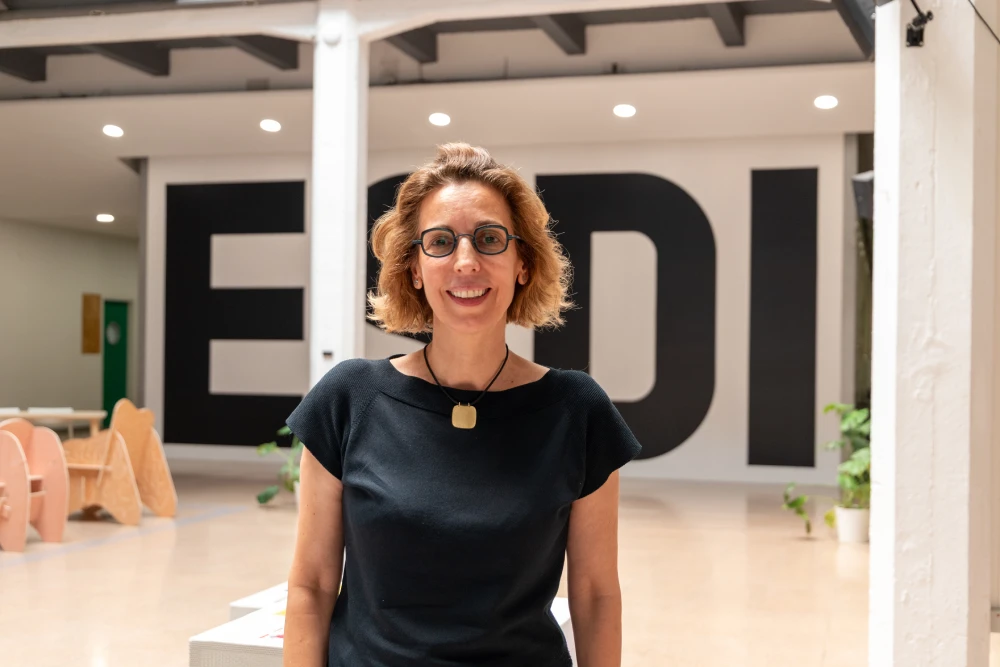
The new president of the Textile Design Foundation is committed to consolidating ESDI as an international benchmark in design, strengthening its connection with the business sector, and promoting a training programme focused on the major challenges of industrial, digital, and sustainable transformation.
The Textile Design Foundation (FUNDIT), which owns ESDI Escola Superior de Disseny, a centre affiliated with Ramon Llull University, has appointed Àngels Chacón as its new president. This appointment marks the beginning of a new phase for FUNDIT and ESDI, aimed at strengthening the school’s role as a leading institution at the intersection of design, business, industry, technology, and social impact, and consolidating an academic model connected to the major transformation challenges facing organisations and society.
Chacón succeeds Carles Casanovas, who led the Foundation for four years. During his tenure, the organisation consolidated its economic and institutional stability, strengthened its governance model, and launched projects that laid the groundwork for a new phase of growth and expansion. Building on this legacy, the new president assumes the role to accelerate this momentum, reinforce ESDI’s position as a leader in design and innovation, expand partnerships with companies and institutions, enhance knowledge transfer, and increase its international reach.
A NEW STAGE FOR ESDI
The new president of FUNDIT, together with General Director Georgina Bombardó, will work to consolidate the school as an institution capable of anticipating the needs of the productive sectors and supporting the transformations redefining business competitiveness. Strategic priorities include strengthening the connection between university, business, and industry; promoting design as a tool for economic and social transformation; enhancing teaching innovation and lifelong learning; accelerating ESDI’s internationalisation through academic and institutional partnerships; and promoting new areas of specialisation related to artificial intelligence, sustainability, ecodesign, user experience, and the creative industries.
This new impetus stems from the conviction that design is now a strategic factor for innovating, generating value and improving the competitiveness of organisations.
“We are living in a time when design is much more than a creative discipline: it is a way of understanding innovation, transforming companies, and responding to major social, technological, and industrial challenges. ESDI has all the necessary assets to become a European leader in this field. We want to strengthen academic excellence, deepen our connection with industry, and project this talent to the world,” says Àngels Chacón.
A CAREER DEDICATED TO INDUSTRY, KNOWLEDGE, AND TRANSFORMATION
Àngels Chacón holds a law degree from the University of Barcelona, specialising in International Trade, and a postgraduate degree in Talent Management in Organizations. Her professional career combines business experience, institutional responsibilities, and leadership in transformation processes. For over fifteen years, she worked in the field of internationalisation for industrial companies, particularly in the Eastern European and Middle Eastern markets. Subsequently, she was the manager of the Unió Empresarial de l’Anoia and co-director of the 4D Health clinical simulation and innovation centre.
In the institutional sphere, she has served as Deputy Mayor of Igualada, President in Spain and Vice-President in Europe of ACTE (Association of European Textile Collectives), General Director of Industry and Minister of Business and Knowledge for the Government of Catalonia, assuming responsibilities in industry, commerce, energy, tourism, universities, and research. She has also held positions in strategy and communications as Director General of LLYC Barcelona and is currently Director General of the Fundació per la Indústria (Foundation for Industry).
This career path provides him with a cross-cutting vision of the relationship between knowledge, business, industry and innovation, as well as a broad understanding of the processes of economic transformation and international projection.